BUILDING
Happy New Year! It’s January 2026. One of the coldest and darkest months of the year in the UK and also one that brings with it a renewed sense of pressure as to what comes next.
New year - new you?
Lists of resolutions. Talking about putting the old year behind us, as though it is something that needs to be done better this time.
I have no problem with the idea that we should be making steps to make things better, but I think that sometimes the pressure of those steps can be overwhelming. What does it mean to improve and who decides what needs fixing?
This year I find myself in unfamiliar territory. My Instagram was hacked last month and I didn’t choose the pause - it was imposed. I usually step back from social media in January, but this time there was no clean ending. My portfolio has disappeared and my network is suddenly inaccessible. I’m not inactive, but I am waiting, having reluctantly realised just how much that I’d come to rely on that small pocket of social media.
There are certain things we grow to depend on that aren’t actually in our control at all, which has made me more aware of how much my newsletter and it’s community really matter, and why wider, more resilient ways of communicating feel so important.
Losing access to something I’d quietly grown accustomed to has made me think more about how systems work - what holds them together, and what happens when they fail. Whether personal or public, digital or physical, the structures we rely on are often more fragile, and more improvised, than they appear.
In my exploration of cities, what fascinates me is the contrast between grand plans and what actually emerges. Cities behave like living organisms - responding, adapting, resisting. Change isn’t unusual; it’s inevitable.
Cities are shaped by people who may never meet each other, making decisions decades apart. The architect of a building or development is rarely the same person that uses the space, so that once the building is finished, things are altered and changed. This isn’t failure - it’s inevitable.
There is a space between the dream and the reality and that is where things really happen.
Cities, like people, are constantly being undone and remade. Plants grow through concrete. Desire lines are created through pristine lawns, because the footpath, though neat on the plan, didn’t reflect how people actually wanted to move through the space.
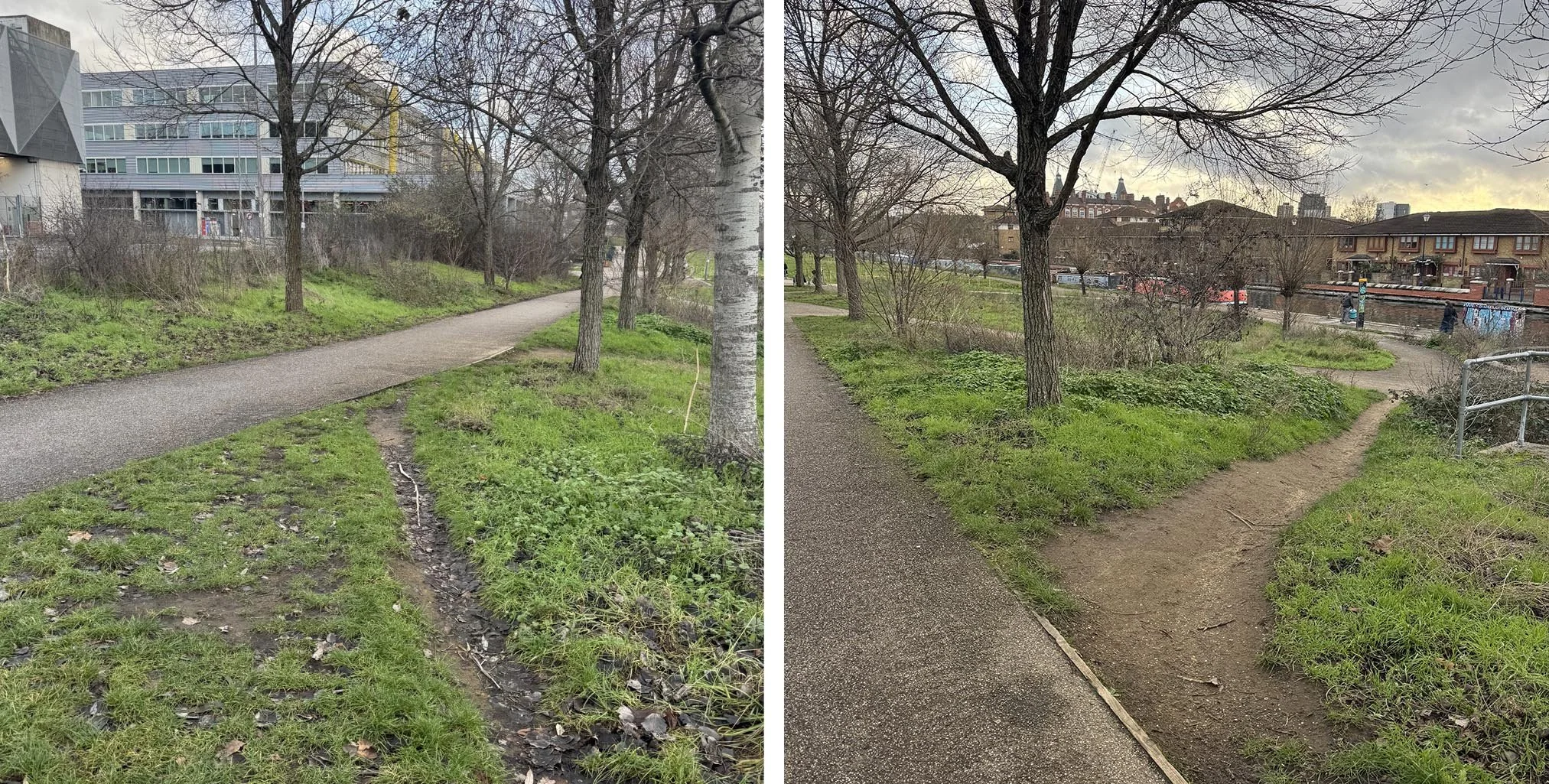
Desire lines, Hackney Wick
It’s easy to talk about improvement - regeneration, renewal, better use of space - but what does better actually mean? In cities, improvement often arrives as optimism while quietly displacing the communities that gave a place its character. For some people this is progress and for others it is felt as a loss. Regeneration doesn’t just change buildings; it recentres who belongs and who doesn’t.
Stability is often an illusion: regeneration is not a clean improvement but a continual overwriting, happening in cycles that, like January itself, don’t respect our need for neat endings or fresh starts.
I wrote about the Fertile Void in September, as I was already spending time with these ideas, but now it feels as though I’ve been offered a second encounter with whatever this space is asking to become.
For now, I’m not looking for answers. I’m quietly getting on with the work for myself and leaning in to trust. That what is meant will still find me, and that it’s OK not to know what happens next.
Maybe January isn’t about becoming someone new, but about learning how to stay present while things rearrange themselves.
Header image by Owen Richards
Questioning when desire lines become paths, Hackney Marshes